
Risk Management
Educationally Speaking… An Apex Trading blog

The week that was…
Anyone active in markets at any level, any part-time trader, investor or general watcher of the financial world will know that last week was a bit special.
We saw huge sell-offs in silver and gold, and a broader sell-off in leveraged assets. Assets that had gone (persistently) parabolic were now headed vertically in the other direction. We watched the narrative ebb and flow around Japan, the tension build and relax around Iran, and the news of new Fed nominees. We could talk for weeks about cause and effect, and we touched on a couple briefly in the last two blogs on Irrational Exuberance and the new market force of retail traders.
Those two blogs and last week’s events have naturally led to the discussions on risk management coming right to the fore again - in the Apex world, ‘risk management’ is as standard an phrase as “good morning!”.
But that’s in the Apex world and is primarily led by Piers and one or two others. In truth, even in that world, it is clear that the ideas and concepts of risk management are very new to many people. Risk management is ubiquitous in many industries, but also there it is remarkably poorly understood outside a small group of specialists and nerds.
It’s worth a deeper look.
Risk Management is a sexy thing….
Risk management is sexy as hell. End of story. If there is such a thing as a secret sauce to life, risk management, done properly, is it. It’s a great-looking thing, and anyone who practises it well is a walking, talking, living, breathing legend.
All of that may surprise a few readers (especially those that have ever worked in insurance or banking!) so I’ll disclose a bias here upfront and early on; not only did I work in a risk environment for many, many years, I was also a Chief Risk Officer during a period of extraordinary change. I came to see and understand risk first hand; what it is, what it isn’t and why most people’s idea of managing it is not just wrong, it’s dangerous….so not only is it sexy as hell, it’s a mysterious little rascal too…..
Every moment, minute, hour, day and week in markets is a moment of learning. Every instance is unique; the combination of factors and variables at that exact moment will have never been seen before and never will again. Take that astounding fact about shuffling a deck of cards; the possibilities are so fantastic that with just 52 cards you will likely never, ever see the deck shuffled the same way twice in your lifetime. That’s with 52 cards.
Now look at a financial market with an infinite number of cards….that’s what you’re dealing with. Yes, some things look the same or feel familiar (parabolic, extended, volatile), but they are only thematically and optically the same. There is no absolute certainty. Add in that the price of a stock reflects a broad view of its future prospects. But of course, the future is unknown; so not only do we have more than 52 cards, we have no clue what those cards might be…. It is that lack of absolute certainty that brings us rather neatly to what risk management really is…..
Risk management - the prince behind the iron mask
This is easy, right? Risk = threats, dangers, perils, hazards, menaces. The possibility of something bad happening. That’s what the dictionary says. So, managing risk is preventing those bad things from happening, right? Well; sadly, in most places, yes – that’s precisely what it is and all it is. You will have come across them; the limits, the guardrails, the ‘rules’, the dreaded risk assessment models, the red/amber/green, all piling up the reasons why you just shouldn’t do something. Why you should stop.
First Error. All of the above is correct, but it is a level one, superficial, ‘control’ minded understanding of risk. And used in isolation these things add almost no value whatsoever. If anything, it may unintentionally destroy value by limiting options in a binary, arbitrary way.
Risk management isn’t just about stopping bad things; that’s easy, just say no. Effective risk management is far, far more potent: it’s actually about making good things happen. Great things.
Uncertainty
Let’s redefine risk - let’s say that “risk is the effect of uncertainty on objectives” [1]
Look at those words very carefully. Here risk is not a thing in and of itself to be controlled with a limit; instead, it is the effect, the outcome of uncertainty. And it isn’t only concerned with bad things, perils or dangers. No. It’s the holistic effect; good and bad. Plus and minus. This shift from risk as an outcome and risk as negative to risk as uncertainty and risk as positive or negative is important for reframing how you view the toolkit available.
This reframes risk management not as a hurdle or a set of gates, but as the assessment of a range of options. By understanding uncertainty and our environment, we can make better choices about what we do, why and how. Risk management then is primarily about decision-making. About great decision-making.
If you want to control an effect, you have to look at the causes. If risk is the effect of uncertainty, then risk management is the management of the causes of uncertainty, and this is where we start to enter into a whole new world that can take us not just to a successful career in trading, but to a more successful, fulfilling and rewarding outcome in every facet of life. …
[1] Typically in finance, risk is the quantifiable bit; probabilities, implied volatility, potential downside, expected losses etc. Uncertainty is then the unknowable element around that. For this blog we talk about risk and uncertainty generally. The math behind probabilities and measurement, etc., is easy to find for anyone with an interest…the wider model of managing risk generally is less well told.
So. This thing ‘uncertainty’ - What is it, how does it arise, and how does it affect us….
I’m a fan of Howard Marks of Oaktree Capital. He has written investor letters for years, in much the same style and manner as Warren Buffett. If you haven’t read them, I highly recommend them (see the reference at the end of this blog).
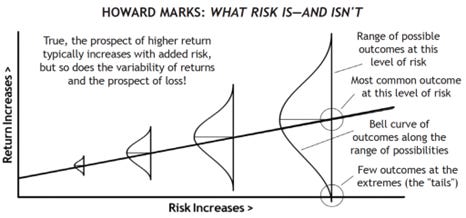
Risk isn’t linear. The graphic above presents the reality of increased risk profiles really well; risk/uncertainty creates a broader range of outcomes; some more quantifiable than others. When we look at that penny stock; its over there on the right….it can go anywhere.
Howard Marks is absolutely spot on when he says that an outcome of understanding uncertainty and volatility [better] in decision making is then using that to find and make asymmetric bets: to make bets (or decisions), where potential gains outweigh the potential losses. Knowing something is risky is only useful if you use that knowledge to reduce the uncertainty so it is in your favour.
He goes on to say that you must also manage risk and make decisions not only in terms of being loss aware but in being aware of missed opportunities and exits. A decisions quality cannot be measured solely by outcome. Make enough significant decisions, you will win; the result will take care of itself. The alternative is relying on luck forever. Good luck with that (pun intended).
Great decision making…
Great decisions, excellent risk management, come from three interconnected places: I group them under Capacity, Capabilities and Controls. They come together to form a robust framework, and all are necessary for it to be effective.
Capacity is about you, yourself. Are you in a place that allows you to think clearly. Do you have a clear mind? Are you focused? Are you making sure you are not overwhelmed? Are you under pressure/stressed? Are you thinking emotionally or objectively?
Capability is about competence. Are you on top of the question? Are you already an expert in your field, or becoming one? In trading, you are competing against the fastest technology and 30+-year veterans. Be brutal; why should you take their money off them? Are you investing in what you need to know technically, fundamentally, macro/micro, risk…. you can be a successful trader but don’t for one minute think you can do it, sustainably, without investing in the knowledge required to understand the game. Know what the volatility and history is of your exposures, know how a book is built..ask lots of questions…
Control. These are your structural guardrails. Your risk capacity. Capital controls, trade limits. These are there to provide you will the big warning signs and alerts that tell you capacity or capability isn’t working right.
To my mind, retail traders need to spend, on balance, much more time on capacity and capability than even professional traders do. And here’s why…..autonomy.
Let’s take limits; one of the BIG differences between institutional and non-institutional. In a big bank, fund etc limits are hardwired into the system. Limits for all sorts of things. Independent risk managers are swarming over the desks, approving trades, etc. All designed to protect the bank, not the trader. As such, a trader can typically only do so much and can’t really blow the place up. If they breach critical limits or whatever, they may well find themselves in the wrong room with HR.
On the retail side however, limits are self-set, self-imposed, and self-regulated. Setting a limit takes 1 sec. Easy. Protected. Not quite. You can choose to ignore it, and nothing happens to you. That is why, from a non-institutional perspective, as useful as learning a limit structure is, it is more important that you develop a really robust system of self-discipline and a solid framework around decision making that really helps you manage emotions, embed self-discipline and so on because that is where the actions occur and protections really exist.
On decisions. When we make decisions, all sorts of things are going on. I recall when I first joined an investment committee. Before then, I, like everyone in the organisation, had opinions – that decision was right, that was wrong, they don’t understand it properly, etc., etc.
Then I sat on that committee, and I had to make the decision; do we let USD100mln go out the door or not? Do we call a default and end this or not? The difference between an opinion and a decision is light and day, and the effect, physiologically and psychologically, is night and day. This is why demo trading only helps so much in preparing to trade. It has zero jeopardy, and jeopardy, the potential to fail, brings out fear – a very real and potent human emotion: fear of missing out, of ridicule, of loss, or failure, of being judged.
How does effective ‘three C’ risk management placate fear?
Effective risk management creates more confidence.
By knowing yourself and your emotions, by developing resilience and discipline, building your Capacity, you create consistency. You take away the fears that surface with avoidable mistakes.
By being expert, or building expertise, building your Capability, you give yourself the confidence to make the call. You know your stuff. You’ve asked the questions and done the detailed learning.
By having tight, relevant Controls, you know that, despite being objective and in control, and being an expert, your framework will support you and will allow inevitable errors, missteps, extraneous shocks, etc., to occur without killing you. They give you time and space.
How can we apply this practically?
Stanley McChrystal said in his book ‘Risk’ that “soldiers and athletes know from experience that the most dangerous opponent is one who lost the last contest but has the humility to learn why – and the discipline to correct their weakness.” The same is undoubtedly true of the trader – the trader who learns is the one always progressing and always in the race.
Here are a few that worked for me. There are hundreds, but it’s a journey for you to explore independently.
Journal. Write, for just a few minutes each pre- and post-trading session, what you are doing, why, your aims and objectives, etc. Write how you feel in yourself. Clear your head and get the ambition out there. Hold yourself accountable. Reflect later on how well that worked out. It’s powerful. Reflect on what trades when well, why? What did you miss, why?
Write before each trade if you can. Ask yourself; is this a good decision? Or is it one based on adrenaline, or drama, on emotion? You’d be surprised how effective it is in controlling emotional trading - it’s the immediate version of the three day rule…
Dedicate a set period of time every week to review and learn something about you, your trades, your market or your product. Commit to developing not just from experience but from conscious choice – it’s a great habit that will see off plenty of avoidable mistakes.
Look after yourself. Fuel yourself well. Trading is mentally taxing. It’s stressful. You don’t need a sugar crash/rush at NY open, you really don’t. You increase the probability of a bad decision.
Picture risk differently. It’s the profile of uncertainty that you need to think about. More risk doesn’t always equal more reward. Mathematically or in any other way, though people would like you to believe it does. More risk means more uncertainty and a greater potential for the result to be wrong. You may not get paid for that. In fact, you won’t. You will get paid for stacking uncertainty in your favour, whatever its profile.
Measure yourself by how many great decisions you made. Keeping that tally will make you think about the next one you have to make. Keep the balance positive.
And stick to the basics; position size, book balance, capital preservation above chasing the sun…..
“As risk concerns uncertainty and as you dive further into its true management you will find one thing; we have more control over how much uncertainty we deal with than we would like to admit. Which means we have far more responsibility for the outcomes than we typically accept.”
‘It’s manipulation’; ‘it’s the market’; ‘it’s retail’; ‘it’s irrational’. Yeah, may all be true. But if we are managing risk appropriately, thinking clearly and objectively, understanding our market and product, the context, assessing and measuring the range of outcomes and the respective rewards and we have taken a manageable and proper position then, frankly, those drivers are things we should chose to accept rather than choose to be surprised by.
And that is exactly how we remove emotion and fear from our trading – by confronting the potential causes of outcomes and owning them head-on.
The Long and the Short of it….
Risk management is about how uncertainty affects objectives. It’s a pile of probabilities. Understanding and managing uncertainty is an extraordinary field of study and activity and is at the very core of trading in financial markets. It simply has to be understood.
Whilst numbers and math matter, really matter, fully effective risk management places equal focus on the person and the context, and it can be some of the simplest things that can really push you forward. How you deal with uncertainty is profoundly personal and idiosyncratic which is why each trader has to find a way of working and a focus that suits them. Enjoy the journey; you will learn more about yourself and people than you ever imagined!
Selected Further Reading:
Against the Gods – The Remarkable Story of Risk Peter L Bernstein
Antifragile and Fooled by Randomness Nassim Nicholas Taleb
Risk Gen. Stanley McChrystal
Unstressable Mo Gawdat
Behave – The Biology of Humans At Our Best and worst Robert M Sopolski
The Most Important Thing Howard Marks
Best Loser Wins Tom Hougaard
More observations to come! If you have any questions or thoughts, please do reach out and share them, but in the meantime; if you are interested to join the Apex Community then here are the links:
👉 Join the Discord: https://discord.gg/apextrading
👉 Activate access via Launchpass: https://www.launchpass.com/apextrading/subscription
Signing off,
Will
Will Jennings is a Founding Member of the Apex community. With a long history in risk management and banking he runs his own risk trading firm. This blog outlines Wills learnings and observations from being a part of the Apex group as well as his own view on the opportunities and challenges of today’s markets.
Well said. Your insights are very damn good. Risk management isn’t about avoiding losses; it’s about making better decisions under uncertainty and staying in the game long enough for edge to compound.
Perfect timing. Risk managment is key, even in Pilates.